[phpBB Debug] PHP Warning: in file [ROOT]/phpbb/db/driver/mysqli.php on line 258: mysqli_fetch_assoc(): Couldn't fetch mysqli_result [phpBB Debug] PHP Warning: in file [ROOT]/phpbb/db/driver/mysqli.php on line 320: mysqli_free_result(): Couldn't fetch mysqli_result [phpBB Debug] PHP Warning: in file [ROOT]/phpbb/db/driver/mysqli.php on line 258: mysqli_fetch_assoc(): Couldn't fetch mysqli_result [phpBB Debug] PHP Warning: in file [ROOT]/phpbb/db/driver/mysqli.php on line 320: mysqli_free_result(): Couldn't fetch mysqli_result [phpBB Debug] PHP Warning: in file [ROOT]/phpbb/db/driver/mysqli.php on line 258: mysqli_fetch_assoc(): Couldn't fetch mysqli_result [phpBB Debug] PHP Warning: in file [ROOT]/phpbb/db/driver/mysqli.php on line 320: mysqli_free_result(): Couldn't fetch mysqli_result [phpBB Debug] PHP Warning: in file [ROOT]/phpbb/db/driver/mysqli.php on line 258: mysqli_fetch_assoc(): Couldn't fetch mysqli_result [phpBB Debug] PHP Warning: in file [ROOT]/phpbb/db/driver/mysqli.php on line 320: mysqli_free_result(): Couldn't fetch mysqli_result Deer attractants in Ontario (urine only) - Excalibur Crossbow Forum
The ban that just came into place only includes body parts of deer including URINE. This was the only focus of the topic. Synthetics can still be used.
Baits, Feed, Apples, Carrots, Corn, Grain, Women and kids all do NOT fall under this category.
Just to make things clear. It's a bogus pass in my opinion but someone had the money to make this thing go through quickly and it truely sucks.
Thanks for clearing that up, yes synthetics are still good to use.
dreamer wrote:.Baits, Feed, Apples, Carrots, Corn, Grain, Women and kids all do NOT fall under this category.
YET!! Im waiting to see whats labeled as " changes pending" in the next MNR regulation book CWD wont spread with saliva transfer from a baitpile, but that wont stop the mnr from banning it.
Ontario has passed an amendment to O. Reg 665/98 (Hunting) under the Fish and Wildlife Conservation Act, 1997. This amendment prohibits possession and use of products that contain, or purport to contain, body parts of any member of the deer family including blood, urine, gland oils and other fluids, for the purposes of hunting. This prohibition applies to body parts and fluids from hunter-harvested deer or moose and applies to all hunting in Ontario.
One potential pathway for the spread of CWD is from possession and use of hunting attractants that contain body parts of members of the deer family. These products contain urine, blood, gland oil or other bodily fluids obtained from captive/farmed deer, elk or other cervids. This regulation also prohibits hunters from possessing or using these types of materials (i.e., body fluids and parts) obtained from wild and farmed cervids for the purposes of hunting in Ontario. These products may contain infectious material and may be capable of introducing CWD to Ontario.
Important Information
Hunters in Ontario may still possess and use artificial or plant-based products that can attract or lure deer and moose but do not contain any body parts of a member of the deer family. These alternative products are commonly available from merchants selling hunting equipment as well as through the Internet.
Why is this Amendment Required?
CWD is not thought to be present in Ontario at this time. However, these products may contain infectious material and may be capable of introducing CWD to Ontario. As the source of these products is often of an unknown origin and from animals of unknown health status, and as CWD continues to be detected in some captive/farmed deer and elk, these actions must be taken to minimize risks.
Possession of High Risk Carcass Parts Originating from Outside the Province Now Prohibited. This applies to all members of the deer family.
Ontario Hunters - if you hunt outside Ontario and bring the carcasses or parts of any member of the deer family (e.g. white-tailed, mule, black tailed or other deer and elk, etc.) into Ontario, you need to be aware that the ban on possessing high risk animal parts now applies to moose and caribou.
The Amended Regulation
Ontario has amended an existing regulation to prohibit the possession in Ontario of high risk body parts and fluids of members of the deer family harvested in other jurisdictions to also include moose and caribou.
High risk parts include the head, spinal column, unprocessed antlers or hide, hoofs, lymph nodes, eyes, spleen, mammary glands, entrails and internal organs. These animal parts are considered high risk because in sick or infected animals they contain prions that may transmit CWD.
The regulation applies to all members of the deer family (referred to as "cervids" and comprising more that 37 species) including all species of deer, elk, moose and caribou that are harvested outside Ontario and transported back or possessed in Ontario.
At the time of the initial regulation proposal, moose and caribou were generally not considered a risk of contracting or transfer of CWD. However, since that time, wild moose in two U.S. states have tested positive for CWD and recent scientific evidence indicates that caribou may be susceptible to infection by CWD. As a result, an amendment under the Fish & Wildlife Conservation Act, 1997 in now in effect. This amendment expands the definition of "cervid" in the regulation to include moose and caribou, so that these species are now also included under the regulation.
Items in the regulation include:
1. It is now illegal in Ontario to possess any part of the antlers, head, brain, eyes, tonsils, hide, hooves, lymph nodes, spleen, mammary glands, entrails, internal organs or spinal column of any member of the deer family that has been killed outside Ontario.
2. The prohibition above (#1) does not apply to finished taxidermy mounts, tanned skin, canine teeth with no tissue attached.
3. Antlers or antlers with skull cap attached may be legally possessed as long as there is no tissue or skin attached to them and they are separate from the remainder of the skull.
4. It is also legal to possess a hide or skin of the head of any member of the deer family including that part of the hide commonly referred to as the "cape" only if:
• all other tissue is removed, AND
• it is kept in an air-tight container, AND
• it is delivered to a tanner or taxidermist within five days of coming into Ontario.
5. If all or portion of the hide or skin of the head identified above (#4) is disposed of, it must be done at a waste disposal site authorized under the Environmental Protection Act such as a municipal landfill.
6. None of these rules (#1 to #5) apply to the prohibited parts (the antlers, head, brain, eyes, tonsils, hide, hooves, lymph nodes, spleen, mammary glands, entrails, internal organs or spinal column) of any member of the deer family if they are transported through Ontario to another jurisdiction in an air-tight container.
7. If you are transporting the antlers, head, brain, eyes, tonsils, hide, hooves, lymph nodes, spleen, mammary glands, entrails, internal organs or spinal column of any member of the deer family in an air-tight container, it must be labelled to show the species of cervid, the place where it was acquired and the name and address of the person who owns the parts in the container.
8. If you have transported a member of the deer family into Ontario that was harvested or killed in another jurisdiction, but later find out that it has tested positive for CWD, you must immediately notify a Ministry of Natural Resources Office and provide information as requested.
Important Information
Hunters will still be allowed to bring in meat and other parts such as antlers and hides, if those antlers and hides are properly treated to reduce risk of CWD transfer (see Items #3 and #4 above).
The regulation applies to all members of the deer family from all states, provinces or other jurisdictions whether CWD has been detected in that jurisdiction or not. The regulation does not affect hunters who have harvested an animal in Ontario. However, persons who wish to export Ontario deer, moose, elk or caribou should check with applicable jurisdictions should they wish to possess these Ontario cervids out of province.
Why is this Amendment Required?
CWD is not thought to be present in Ontario at this time. However, it's possible that by transporting out-of-province infected parts of carcasses into Ontario, disease-causing prions could be spread into the environment. These prions may live for years, increasing the risk that Ontario deer, moose, elk or caribou could become infected with CWD. This regulation will minimize that risk.
Most North American jurisdictions, whether CWD is present or not, are taking steps to minimize the spread of CWD. Manitoba and more than 20 states in the United States have already taken action to address the spread of CWD through high risk carcass parts.
Transport of Live White-tailed Deer, American Elk, Moose or Woodland Caribou into Ontario Now Restricted Unless Accompanied by a Provincial Permit
Transporting live white-tailed deer, American elk, moose, woodland caribou and their hybrids into Ontario now requires a permit under a new regulation under the Fish & Wildlife Conservation Act, 1997. This applies to the transport of live white-tailed deer, American elk, moose and woodland caribou into Ontario for any purpose, including farming, slaughter, and display in zoos.
Anyone wishing to transport live white-tailed deer, American elk, moose or woodland caribou into Ontario is required to meet new conditions to minimize the risk of spreading Chronic Wasting Disease. MNR now requires written notice regarding health status and documentation of a premise assessment from the Ontario Ministry of Agriculture, Food and Rural Affairs (OMAFRA) before issuing a permit to transport these species into Ontario. Information from OMAFRA on the permit system.
For information about these new requirements and about the process for applying for a permit please contact:
•the Animal Health Coordinator with Ontario Ministry of Agriculture, Food and Rural Affairs (OMAFRA) at (519) 826-7612, or
•the Wildlife Health Policy Advisor with the Ministry of Natural Resources (MNR) at (705) 755-1573.
Why is this Regulation Required?
Chronic Wasting Disease (CWD) is a degenerative, fatal brain disease that affects certain members of the deer family, including white-tailed deer, elk, and moose. The disease is believed to be caused by abnormal proteins called prions. CWD is in the same family of diseases as bovine spongiform encephalopathy (BSE or Mad Cow Disease).
There is no evidence to date that CWD can be transmitted to humans or to domestic livestock such as cattle. However, CWD has been detected in wild and/or captive/farmed deer, elk or moose in 18 U.S. states and two Canadian provinces. There is a significant risk to wild Ontario deer, elk, caribou and moose if CWD enters Ontario as the disease is fatal in these species and there is no cure.
CWD is not believed to be present in the wild in Ontario. One potential pathway for the spread of CWD is the movement of infected cervids and/or their hybrids from other jurisdictions that could spread infective prions to other wild or captive animals in Ontario.
Related Links
More information on the regulation is available on the following websites:
•Government of Ontario e-Laws website - Regulating Possession of Cervids to Prevent Chronic Wasting Disease
Exocet 175
Munch Mount
ComfyBear String
DaGriz Knife
i bet canada has area's with CWD that hasn't shown up yet....there really is no area in north america it can't be or isn't yet, just hasn't been found yet like rabies in coons, foxes etc..........bob
....
exocet 200. STS dampers.
boo string and trigger work.
munch mount quiver mount.
125 gr slick trick magums.
2" blazers on 2117 XX75 w/ brass inserts.

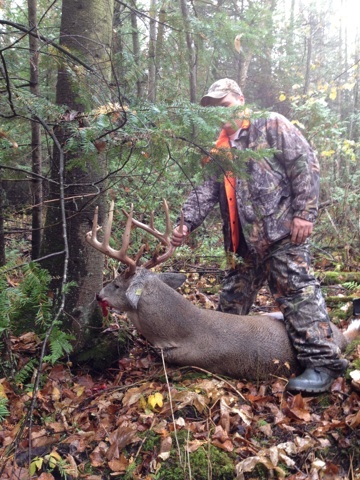
 CWD wont spread with saliva transfer from a baitpile, but that wont stop the mnr from banning it.